
Credits
Germa Adan
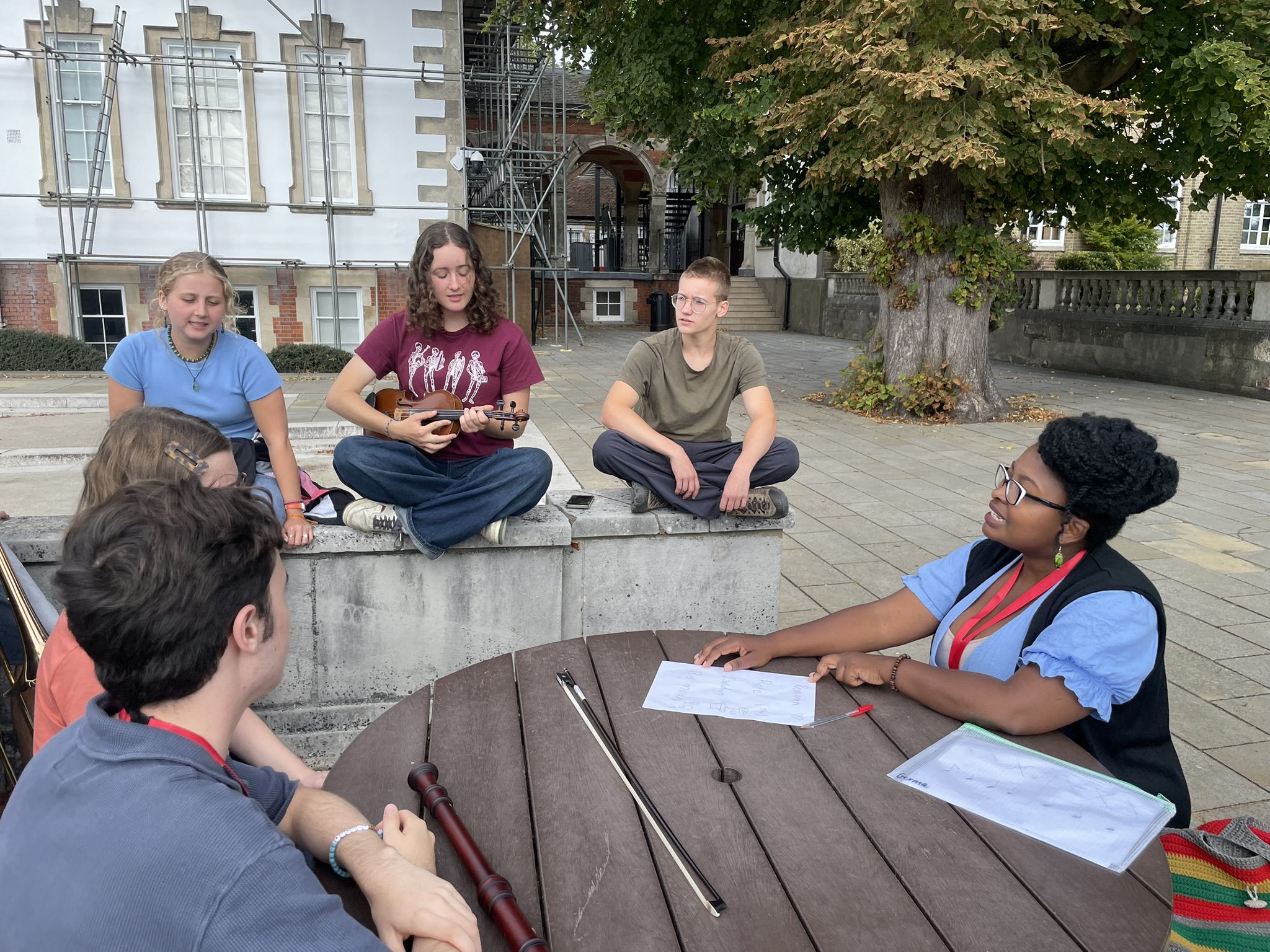
This resource has been curated by Germa Adan - a Haitian-born composer, vocalist, string musician, educator and artist-researcher whose work explores Haitian, American and British folk traditions alongside wider Afro-diasporic musical practices. Born in Les Cayes, Haiti and having lived in both the United States and the United Kingdom, her transatlantic experiences shape a musical practice rooted in oral tradition, cultural memory and creative exploration.
Her performances combine voice, violin and classical guitar, drawing on oral history, literature and lived experience to create immersive musical experiences centred on listening, storytelling and cultural connection. Alongside her performance practice, Germa designs inclusive and culturally responsive music education resources that encourage curiosity, creativity and shared music-making.
Her acclaimed album Borderlines & Bloodlines explores Haitian heritage, literature and oral histories through original compositions shaped by traditional influences. The album was named one of Folk Alley’s Best Traditional Albums of 2023 and was described by Songlines Magazine as sounding ‘unlike anything else out there.’
Germa has worked with the English Folk Dance and Song Society as a tutor with the National Youth Folk Ensemble, co-creating arrangements of two Haitian traditional songs that she taught the young musicians – Bon Tan in 2024 and Nan Fon Bwa in 2025.
Alongside her artistic and educational practice, Germa is currently a researcher exploring Francophone Caribbean vocalisation, oraliture and embodied vocal practice. Her research investigates how voice functions as a carrier of cultural memory, historical knowledge and cultural continuity, and how Haiti-centred vocal traditions challenge inherited understandings of classical voice, musical legitimacy and vocal pedagogy. Working across music, literature and performance, her research and creative practice continually inform one another.
Image: Germa Adan teaching the National Youth Folk Ensemble, August 2025, photo EFDSS
Steveen Ulysse

Steveen Ulysse is a sociologist and researcher at the University of Glasgow, where he is a Postgraduate Researcher in Sociology and a James McCune Smith Scholar. His work explores Vodou and other Afro-diasporic spiritual traditions, focusing on how religion, sound, and ritual shape identity, community, and cultural life across the African diaspora. His research is grounded in long-term engagement with the Vodou community in Brooklyn, New York, and brings together ethnography, history, and creative practice. Steveen is currently working on a book project that centres on drumming and sonic traditions within Vodou, developed in collaboration with the Haitian Studies Institute in Brooklyn, working with Dr. Lily Cerat, and Jaïra Placide. He has also served as a Visiting Scholar at the City University of New York (CUNY), where he worked closely with community members, artists, and practitioners, to explore contemporary Vodou in Brooklyn.
Steveen’s work has been recognised with the David Ford Memorial Prize (2018) and the Emerging Scholar Award from KOSANBA, the Scholarly Association for the Study of Haitian Vodou (2025). Alongside his research, he teaches Sociology at the University of Glasgow and collaborates on public and creative projects that bring scholarship into dialogue with sound, art, and performance, including co-organising Yoruba Sonic (2023) with Glasgow International. Steveen remains committed to ideas of Konbit, and Konesans.
Image: University of Glasgow Photographic Unit