English Dance and Song August 2026
This news item is based on articles in English Dance and Song, the magazine of the English Folk Dance and Song Society. The world’s oldest magazine for folk music and dance, EDS was first published in 1936 and is essential reading for anyone with a passion for folk arts.
Chloe Middleton-Metcalfe, of Sheffield Sessions Festival’s Family Fringe, offers tips on welcoming families to folk events.
Before I became a parent my interest in folk music and dance was a core part of my social life and identity. I had no idea when I was pregnant how much the mere presence of a baby or child (no matter how innocent looking) would influence my ability to participate at folk festivals and sessions. I naively thought that any child would just be able to fit around my lifelong love affair with traditional culture. How wrong I was.
When we go out with the family, which has now expanded to three young ones (currently 5,4 & 0), I don’t even drink tea because holding a cup of hot liquid whilst managing the young ‘uns is more stress that it is worth. No wonder so many parents experience the ‘happiness gap’, a decline in subjective wellbeing after the birth of the first child.1
It seems to me that families are generally under-catered for in the general folk offering. One organiser of the children activities at a well-known folk festival told me that they are organising events for the children, not for the parents. Fair enough, but I don’t think my toddler would have been able to make the 190-mile journey there without me.
Family events offer a great opportunity for children to be introduced to participatory traditions in a communal rather than institutional setting. This is something which Fay Hield explicitly raised during the University of Sheffield’s Access Folk podcast.2 Sing-arounds, she notes, require a different skill set to choirs whilst sessions are different to ensemble performances. With so many of these events happening in non-minor friendly environments (the pub) she asks, “Where are the singers going to come from?” Don’t worry Fay I have the answer – family orientated folk events!
I won’t be talking here about safeguarding, DBSs, insurance, risk assessments, photo privacy, allergies, etc; you can find all that information elsewhere (including efdss.org). Instead, I want to give some simple tips to encourage organisers to consider running family-friendly folk events.
1. Folk it Up: Why should folk-curious families come to your event and not go to the zoo? Because they are interested in folk of course! Lots of commercial events use a ‘folkie’ vibe to entice families. Don’t shy away from putting on actual folk material and not just the generic children’s content (such as parachute and bubble machine) which participants can access at home.
2. Make it easy: At one children’s event we attended a tree had been roped off to preserve its roots. The memory of trying to stop my toddler running around that tree still gives me heart palpitations. If only the organisers had put the activities in a safe contained space! So simple but so important. Put out of sight anything you wouldn’t want thrown across the room. Make events suitable for all ages as often children are part of a sibling set. Ideally allow food brought in from home to be consumed in the space. Make it explicit that breastfeeding is welcomed with a sign at the door and provide a basic armless chair for nursing mothers. Make sure the toilets and nappy change area are close and clearly signed.
3. Manage expectations: Set out clear expectations in advance which makes any later enforcement much easier. EFDSS’s Family Barn Dances at Cecil Sharp House have a a strict rule that all under 5s must dance with an adult. This rule is made clear and is very, very sensible! Are you putting on a 45-minute show? Make it obvious in advanced whether children are expected to be quiet and sit still, or if the performance is ‘relaxed’.
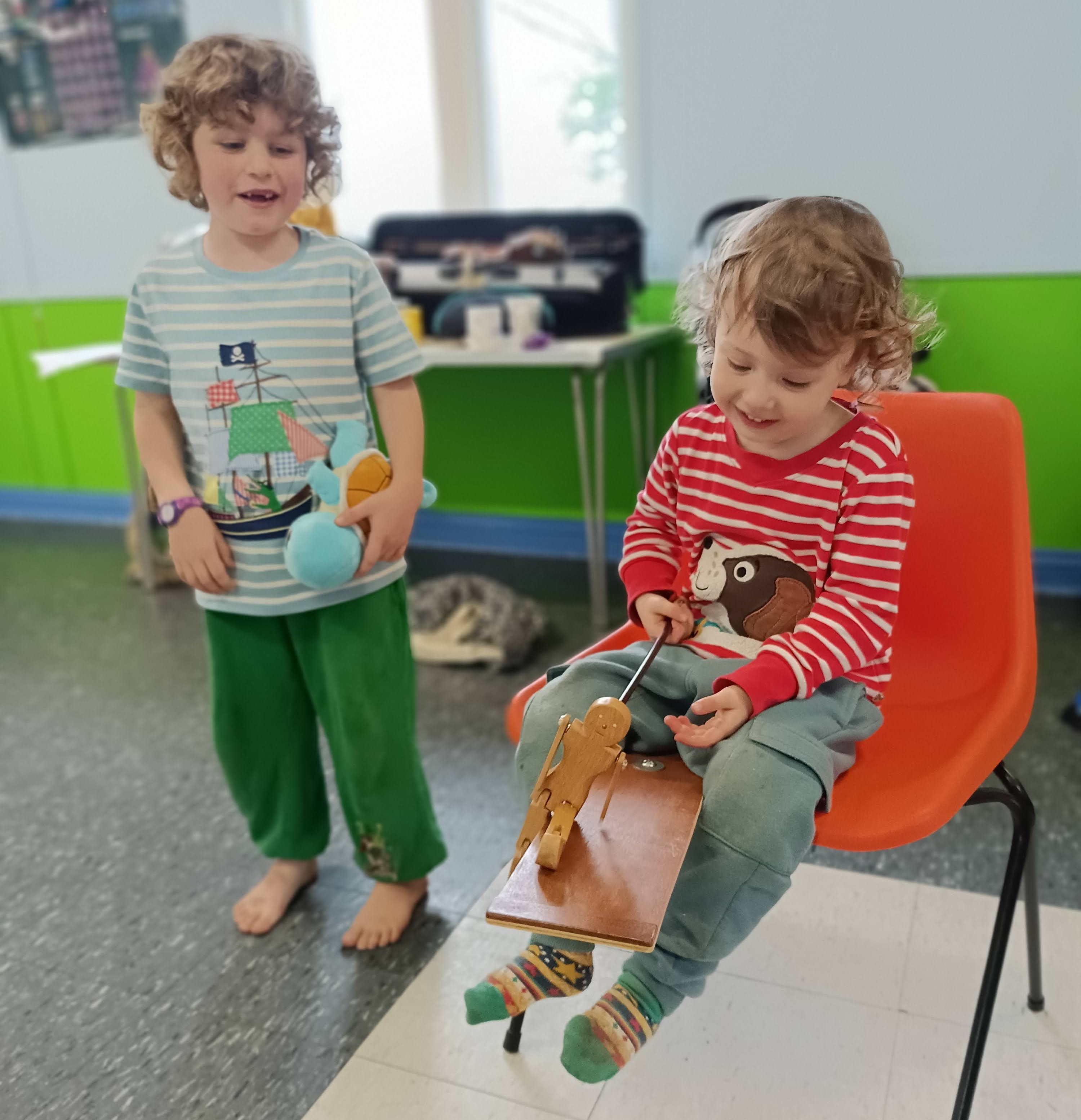
4. Toys: The Family Fringe, and similar events such as the Ely Family Sessions, work because children have the option of joining in with the music or playing with toys. This is continually raised as a positive by parents and children on our feedback sheets.
5. Is this really what you want? Do you really want families at your event? I know of a family event that was cancelled after a child vandalised a valuable instrument with a permanent marker. Don’t romanticise childhood or parenthood, think of the worst-case scenario and apply it to your event. Perhaps hire a child friendly venue, rather than one with heritage plaster work, and make sure that no permanent marker pens are left lying around!
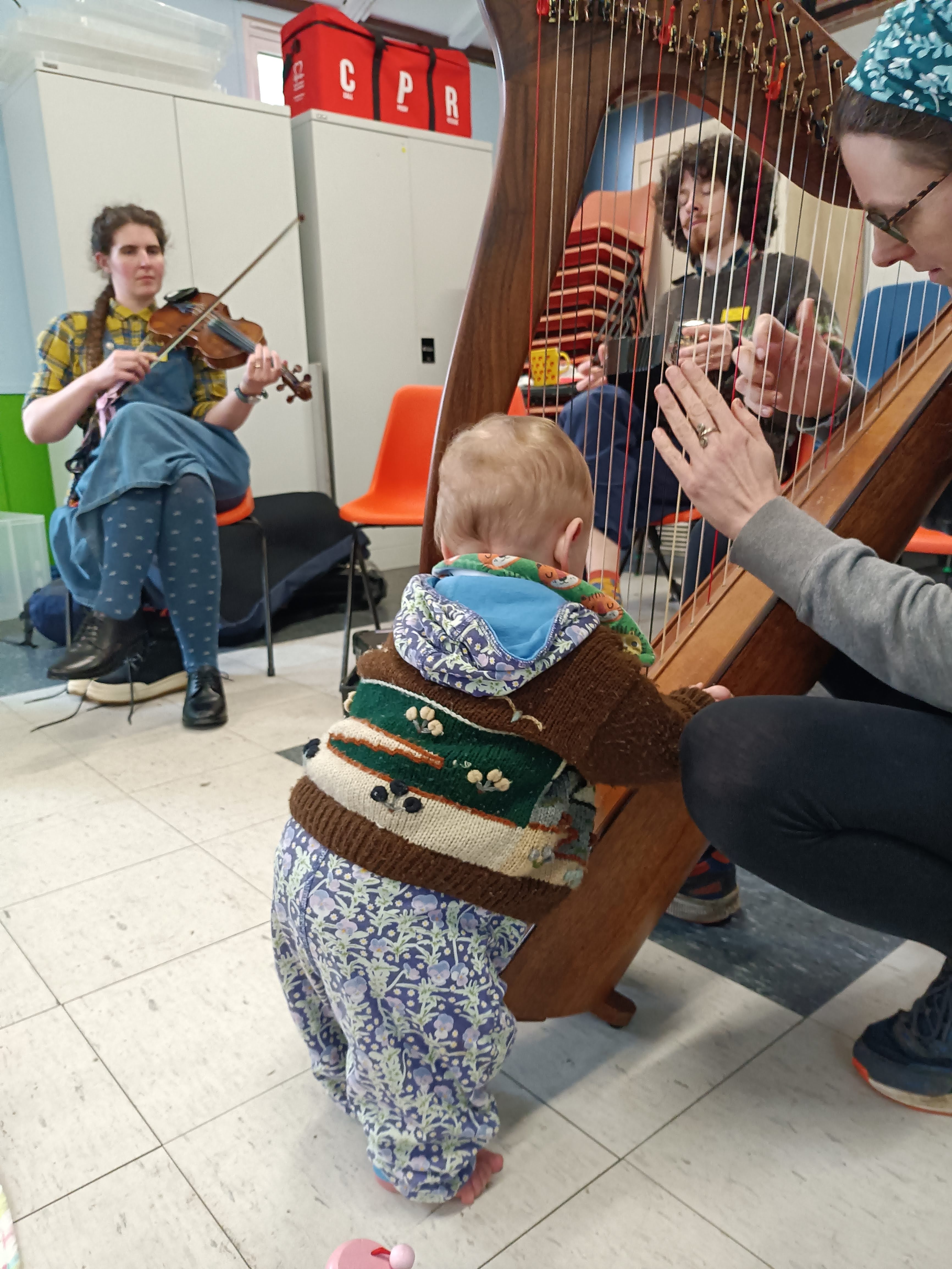
If we want to encourage the next generation then I suggest that family events are the way forward. The days of Dad going to sessions in the pub while Mum looks after the children are over. Now both parents want a chance to engage with traditional music, song and dance culture with their children. Parents have told me that the Sheffield Family Fringe was the first time they had been able to play music socially with others since the birth of their children – up to five years ago! That suggests a lack of general provision for such events. And it is not just about the culture-starved perpetually harassed parents either. Seeing adults engage in participatory music and song is very powerful, and if my own experience of family music making is anything to go by, it is likely to encourage the next generation to incorporate this music into their daily lives.
Chloe Middleton-Metcalfe is a Doctor of Dance, musician, folklorist and mother of three. In 2023 she established the Sheffield Sessions Festival ‘Family Fringe’. Discover more at chloemiddletonmetcalfe.uk
1. P.289 https://www.demographic-research.org/volumes/vol39/9/39-9.pdf
2. Access Folk: Increasing Participation and Inclusion” 00:06:59 https://accessfolk.sites.sheffield.ac.uk/resources/podcast
Images by Chloe Middleton-Metcalf and Christian Reynolds
This is just one of our resources for members. Join us now to become part of our welcoming community and to show your support of folk music, dance and song in cultural life – past, present, and future
Support us, and support the folk arts
We champion folk music and dance at the heart of cultural life, all across England.
Donations provide immediate support. But even more than that, they prove that so many people value what we do – helping us to secure funding from partner organisations.
Can you donate today?