

Your accountLog in Basket Search
Folk England Folk England
Cecil Sharp House Vaughan Williams Memorial Library National Youth Folk Ensemble

Support our work

US tax-efficient giving now available

Give now

Support our work

US taxpayers, make a tax-efficient donation and help us to maintain and expand our resources for folk arts practitioners and researchers

Give now

Support our work

We champion folk music and dance at the heart of cultural life, all across England. Can you support the folk arts with a donation today?

Give now

Support our work

We champion folk music and dance at the heart of cultural life, all across England. Can you support the folk arts with a donation today?

Give now

Support our work

We champion folk music and dance at the heart of cultural life, all across England. Can you support the folk arts with a donation today?

Give now
Donate Image Logo
  • Cecil Sharp House
  • Vaughan Williams Memorial Library
  • National Youth Folk Ensemble
  • What’s on
    • Gigs
      • 20% Sharper Discount
      • Rooted and Rising on Tour
    • How to book
      • Travel to Cecil Sharp House
      • Access at Cecil Sharp House
    • Classes & Courses
    • Conferences & Talks
    • Dances
      • The Folk Dance Calendar
    • Exhibitions
      • Past Exhibitions
    • CPD
  • Learning
    • Young People
      • National Youth Folk Ensemble
      • Dance
      • London Youth Folk Ensemble
      • Disabled Young People
      • Folk Unlimited
    • Adults
      • Cecil Sharp House Choir
      • Sunday Folk Music Workshops
      • Dance Classes
      • Lectures and Talks
      • Monday Folk Singers
      • Folk Beyond
      • FAQs
    • Families
      • Family Barn Dances
      • Family Friendly
    • Practitioners
      • Professional Development
      • Dance Development
      • Dance Mini Grants
      • Folk Education Network
    • Resources
      • Beginners’ GuidesBeginners’ Guides
      • GlossaryGlossary
      • A-ZA-Z
      • Resource Search
    • Schools & Colleges
      • Artsmark
  • Artist Development
    • Artists
      • Showcases
      • Commissions
      • Bursaries
      • Bursary stories
      • Bursary reports
      • Micro Grants
      • Musicians in Museums
      • Other Opportunities
    • Partners
      • Associate Company
      • Associate Artists
      • English Folk Expo
    • Folk Discovery
      • Bhangra Ceilidh
      • Rooted and Rising
    • At Cecil Sharp House
      • Programming
      • Exhibitions
  • Support us
    • Donate now
      • General donation
      • Regular donations
      • Gifts in wills
      • US giving
    • Support an activity
      • Library
      • Dance Development
      • National Youth Folk Ensemble
      • Children and Young People
      • Artist Development
    • Membership
      • Starter Membership
      • Individuals
      • Groups
      • Libraries and Institutions
      • Insurance
      • Renewing Individual Membership
      • Renewing Group Membership
    • Folk Shop
      • CDs
      • Publications
      • Book and CD Sets
      • Merchandise
    • Gift vouchers
  • About us
    • What we do
      • News
      • Advocacy
      • Equity, Diversity and Inclusion
      • Mission, Vision and Values
      • Press and Media
      • Library
      • Partner Organisations
      • APPG for Folk Arts
    • Who we are
      • Staff
      • President
      • Annual reviews
      • Annual General Meetings
      • Board
    • Our history
      • Past projects
      • Gold Badge Awards
      • Local Heroes
    • Publications
      • Folk Music Journal
      • English Dance and Song
    • Folk Player
      • In the Archive With...
      • Listen: Classic Folk
      • Folk Folk
      • Old Songs Podcast
      • Young Folk Club Playlists
    • Work for us
      • Vacancies
      • Work Experience
      • Volunteer
  • Venue Hire
    • Seperator Test (3)
    • Seperator Test (4)
    • Seperator Test (5)
    • Hire our Venue
      • Weddings
    • Seperator Test
    • Seperator Test (2)
    • Seperator Test (3)
      • Public Liability Insurance
      • Free Fundraising
      • FolkSafe safeguarding
      • People Dancing online learning
    • Advice and Resources
      • Welcoming families to folk events
      • Should my folk group become a Charity?
      • Advice for Dance Clubs
  • Members’ area

Linett Kamala: creator of Basstone Maypole

Monday 12th of October 2026

DJ, artist educator, Notting Hill Carnival Board Director and founder of LIN KAM ART, on how she is reinventing traditional maypole dancing by adding LED lights as ribbons, Jamaican dancehall beats played through a fully integrated sound system.

Growing up, where did your music and dance influences come from?
I was born in 1970 in Harlesden – one of the most culturally diverse boroughs in London – to Jamaican parents. I had many musical influences. One of my earliest memories is dancing to Barry White’s You’re my first, my last, my everything whilst standing on top of
my mother’s feet whilst she held my hands. My father was a musician and toured solo to pubs across the country playing his guitar whilst singing a mixture of country and western tracks, and music by Jimi Hendrix. I also had an incredible school dance teacher who took us to see dance productions at Sadler’s Wells.

How did you first find maypole dancing?
I was first introduced to maypole dancing at primary school, and I remember finding it both fun and challenging. At secondary school, however, the focus shifted to contemporary dance. Nowadays, I’m always learning and was pleased to get support from Natasha Khamjani and Kerry Fletcher from Folk Dance Remixed and Beverley Bogle of Januka.

And how did you discover maypole dancing in Jamaica?
In Jamaica in 2020, I visited a school in the parish where my family originated from with a day of art workshops based on my exhibition ‘My heart will always belong in Brixton: Olive Morris’. There I noticed a white pole with colourful ribbons upright in the classroom. I was gobsmacked to be told that it was indeed a maypole and that the children practiced dancing it daily after school; I had never seen it danced in this style before! I was taken by the music which was being played from a car stereo; it sounded like an ancient form of call which I later found out was known as Mento music. I also loved the footwork. There was a shuffle, Dinki
Mini, to the movement when taking the steps and the girls performed the most integrated weaving with the ribbons on a scale of position. I was in awe that this artform was alive and vibrant in the remote hills of Jamaica.

What appealed to you about the maypole?
I love that it’s something that you do in unison with others. There’s a joyfulness to it and I love that it is connected to nature in terms of welcoming in the spring. I was taken by the distinct twist on this English tradition seeing it infused with Jamaican culture. I was also the DJ for Folk Dance Remixed and enjoyed their approach to fusing it with Hip Hop culture.
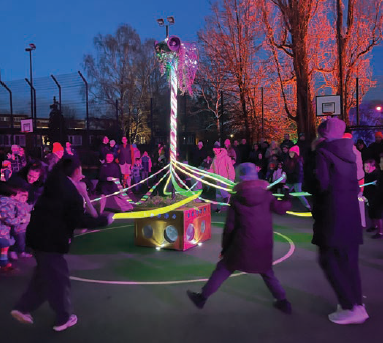
Basstone Maypole in action

How was Basstone Maypole born?
I had been dreaming about dancing in the maypole again for quite a while. There was a particular dancehall instrumental riddim called Jonkonnu which when I first heard it, I visualised people dancing the maypole to it with onlookers clapping along. In 2024 I made my first light and sound system installation called BASS REGENERATION for the Light Up Kilburn festival – it was an instant hit. When an opportunity came up two years later to create a second light installation, I was excited to bring my ideas and drawings for Basstone Maypole to life. Being English with Jamaican heritage, and my love of sound system culture since DJing as a child at the Notting Hill Carnival back in 1985, all played a part in me coming up with this take on this traditional folk dance.

Why do you think it’s important to keep traditions alive?
I believe to understand who you are, it’s important to know your past. I am a descendant of enslaved people who had their past forcibly removed and hidden from them. Other elements such as indentureship brought a mixture of influences where much of the past was kept alive through dance and oral storytelling. In these ever-changing fast times, traditions such as maypole dancing can help to give a sense of identity and connection and belonging. You also know that you’re continuing something which has been passed down for generations and handing it over to the future generations to create their own version of this tradition.

Who has been the biggest cultural influence on your career?
Jamaican sound system culture fused with my English upbringing has played a big part, as well as artists such as Robert ‘Bob’ Nesta Marley and Miss Louise Bennett have inspired me from the perspective of championing wisdom handed down over generations to uplift others and have a sense of pride in your cultural roots. I have also been drawn to the thinking of the surrealist art movement.

Basstone Maypole is a wonderful way of introducing new people to dance. How does this make you feel?
It’s like a dream come true for me to see the joy Basstone Maypole brings – and for many, it’s the first time they’ve danced the maypole. I wanted them to have a sense of wonder and be literally drawn towards it, and that is exactly what happens when people see Basstone Maypole for the first time. I’ve been inundated with such positive responses following my interview in The Guardian
(‘Maypole is Massive!’) and I’m proud it has toured to the Queen Elizabeth Olympic Park and The British Library.

For more information on Linett Kamala visit her social media
@linett_kamala 
@lin_kam_art

Linett will be running a Basstone Maypole workshop at the Black British Folk Takeover at Cecil Sharp House on Saturday 17 October. Places will be limited and available to book on the week of the event

Book for Black British Folk Takeover

Photos by Linett Kamala


Contact us
Travel
Access
Folk Shop
The Folk Dance Calendar
Policies and Guidelines
Safeguarding
Code of Conduct
Booking T&Cs
Terms of Use & Cookies
Manage Cookies
Facebook
Instagram
Bluesky
YouTube
LinkedIn
TikTok
Subscribe to our newsletter

English Folk Dance and Song Society, Cecil Sharp House, 2 Regent’s Park Road, London NW1 7AY, UK.
Tel: 020 7485 2206 | Email: [email protected] | Registered charity number 305999
Cookies: The English Folk Dance and Song Society’s websites use cookies: please read our cookie policy for more information.

© 2026 EFDSS.
Supported by Arts Council England