

English Dance and Song August 2026
This news item is based on articles in English Dance and Song, the magazine of the English Folk Dance and Song Society. The world’s oldest magazine for folk music and dance, EDS was first published in 1936 and is essential reading for anyone with a passion for folk arts.
Daisy Black and Andrew Swaine share their enthusiasm for Playford’s music and dance with new and experienced dancers.
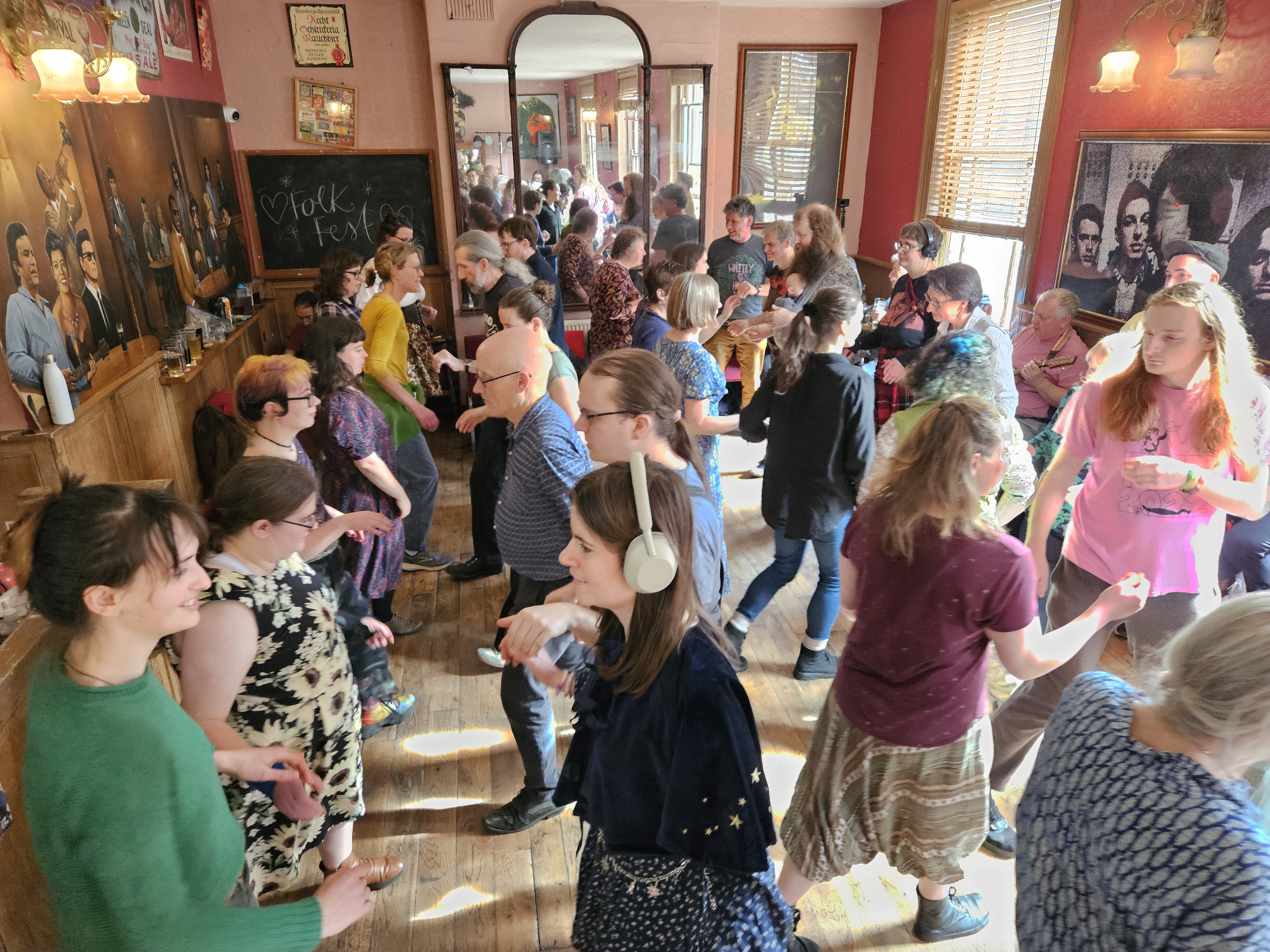
38 musicians, crammed into a pub, play Childgrove with gleeful abandon. 42 dancers spin and swirl, clap and connect, forming figures of eight into a space slightly too small for them. The musicians change keys, accentuate rhythm, and sing a sudden chorus of miaowing certainly never dreamt of when this dance was published in 1701. We came into historical dance through ceilidh. After attending The Round (a lively Cambridge intergenerational dance club), we found in early dances a similar potential for excitement, improvisation, punctuation and precision. Playford published some of the best tunes in the English canon, so when we moved to a city with many excellent folkies, we wanted to start a session that was as much about the musicians as dancers.
In 2014, Sheffield’s monthly Playford in the Pub was born in the room above Shakespeare’s: a well-known folk venue small enough to feel friendly even on weeks with fewer dancers. Friends from Folk in South Yorkshire joined and shared their expertise, but we mostly got people entirely new to Playford, invited through our morris and session communities, and University of Sheffield’s CeilidhSoc.
As far as we’re concerned, Playford dances are just country dances that happen to be old. We go back to the source and try to reproduce the dances’ original fun, rather than overly ‘improve’ them. Playford’s repertoire has something for everyone: dances that lift you into the air, sweeping, stately dances, intricate patterns and 3/2 hornpipes with driving rhythms that make the dancing fly.
If the musicians aren’t enjoying themselves, the dancers won’t either. We find dances with tunes the musicians want to play, and typically play them the same way you would for ceilidh. We keep chords simple so the musicians can get into a groove.
We’re not alone. In 2011, Rhodri Davies and Mike Barraclough wrote a Zesty Playford Manifesto. Jen Morgan’s Coventry Zesty Playford provided foundations for lively Playford at Inter-Varsity, Chippenham and Sidmouth Folk Festivals. Other daft Playford shenanigans include late-night scratch ‘Playford on the Sidmouth Esplanade’ and John Sharp organising contra-medley style Persistent Playford sessions at Inter Varsity Folk Dance Festival (IVFDF). As the scene above describes, the musicians and dancers at our packed Playford slot at Sheffield Sessions Festival are very open to not taking things too seriously.
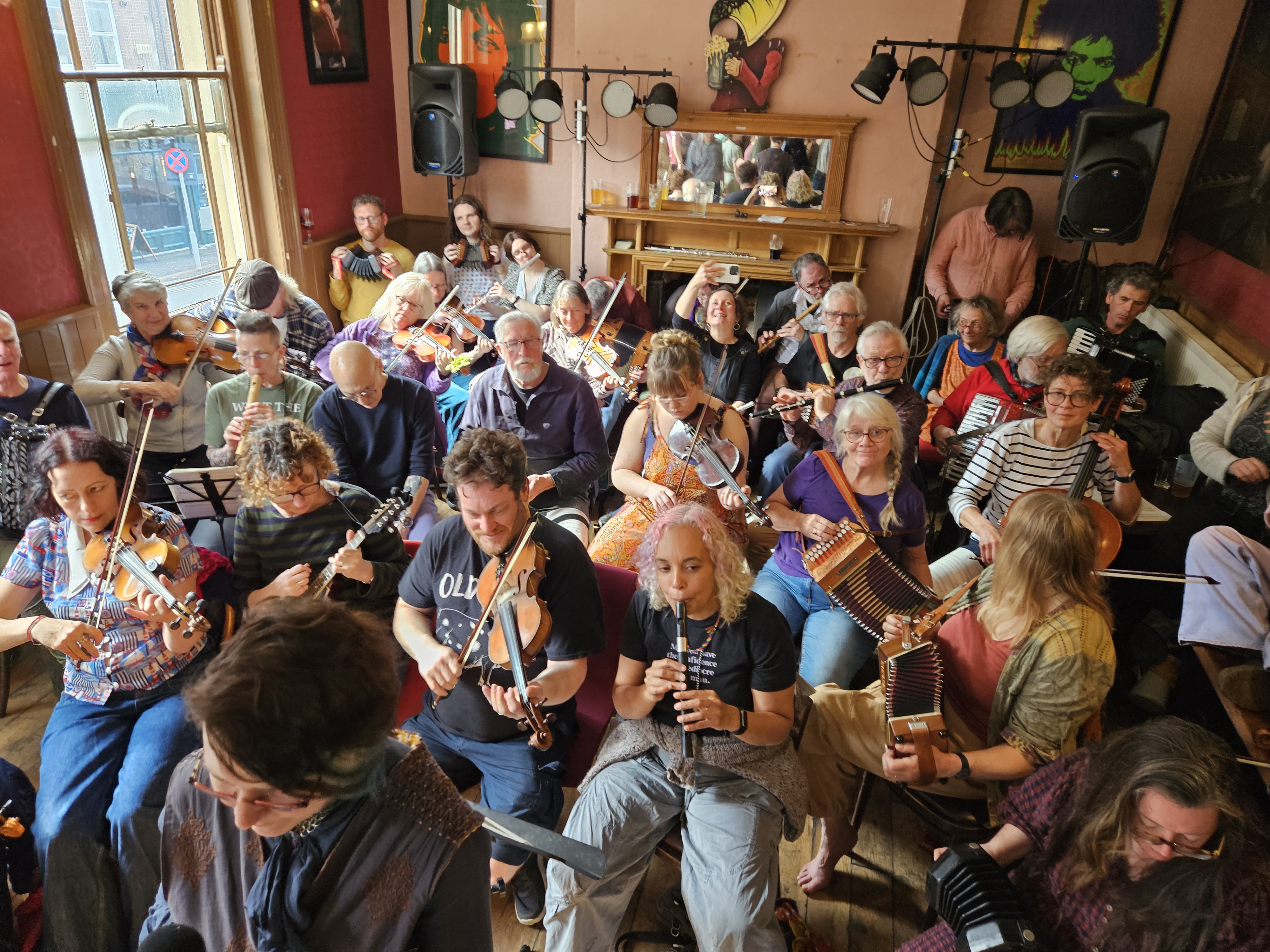
Dancers, callers, musicians and beginners are all welcome
One barrier for new dancers is a fear of ‘getting things wrong.’ It takes courage to join a community, or to drop into an unfamiliar festival workshop. Many groups have shared great practice in this magazine about how to be welcoming and inclusive. Some things we do are:
• If someone new arrives, work out why they are there. What are they hoping to learn? How can your group support them in that?
• Assume the first dances need to be accessible to someone with little experience and need more detailed teaching. Style points can give experienced dancers new things to focus on. Likewise, first tunes need to be catchy and easy to pick up.
• If new dancers come together, don’t split them up. They had the courage to come with a friend. Being obliged to change that can be scary. Don’t smother them with attention but do ask them to dance!
• Use a calling style to suit your audience’s needs. Both of us can call positionally or using role terms, and match our calling to the communities we work with. Playford in the Pub is an intergenerational community, and contains several people for whom gendered role terms would be off-putting. It is important they can dance any role with their chosen partner without being ‘corrected’ or separated. We advertise our gender free calling so anyone coming knows what to expect
• Embrace the fun of getting it ‘wrong.’ Callers mess up things they are trying for the first time. Musicians choose inadvisable keys. Dancers go in the wrong direction. Nobody knows exactly how 1651’s dancers did it anyway. Going wrong is a key part of learning, and should be enjoyed.
• Make it fun with whoever turns up. Once, we had one musician and four dancers, so we played with Playford’s excellent 4-person dances.
It is embarrassingly easy to organise folk events in Sheffield, with a population of keen musicians and dancers up for trying new things, but there are opportunities in many places.
- Look at who you already have in your community. Share Playford tunes at sessions (or see if they already play them). We started a Facebook group, took flyers to events and advertised via local calendars and networks. We include Playford in our ceilidh repertoires and say, ‘it’s as fun as this, but older.’
- Look at adjacent communities. Regency dance and Jane Austen are currently having a ‘moment’ and historical costuming has a dedicated following. Georgia Delve and the Warleggan Village Band work highly successfully with these communities. LARP (Live Action Roleplay) and historical re-enactment groups are also interested in historical dance. Find out who is in your area and offer a workshop.
Outreach is not mandatory: it’s perfectly fine if your group is you and your friends. As packed Playford and Regency dances at Oxfolk and major folk festivals suggest, the interest is out there. These dances survived centuries of Puritans, plague and politics. They are not going anywhere.
Playford in the Pub meets on the last Thursday of every month at Shakespeare’s in Sheffield. Find out more: facebook.com/groups/SheffieldPlayford
Photos by Andrew Swaine
This is just one of our resources for members. Join us now to become part of our welcoming community and to show your support of folk music, dance and song in cultural life – past, present, and future
